"Business"
The Two Timelines Behind a Mold Inspection Result
By Headlines Team
November 12, 2026
Field Notes
|
What this covers
|
Almost everyone who asks how long a mold inspection takes is solving a diary problem. Do I take a half day off. Do the tenants need to be out. Can this happen between a showing and a closing.
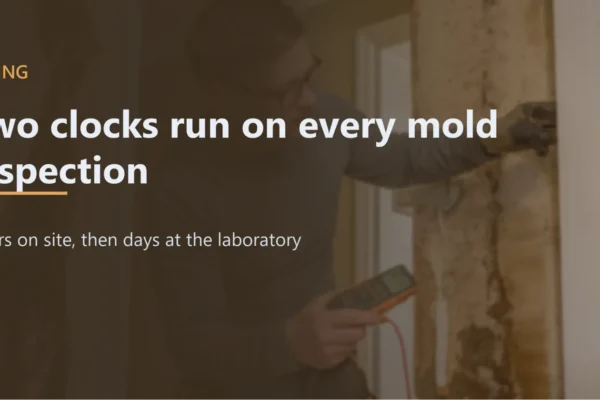
The useful answer has two halves, and most quotes only give the first one. Two to four hours on site for an ordinary single-family home is the appointment. The answer is a separate clock, and it usually runs longer.
What the Hours on Site Are Spent On
The visit is not somebody walking around looking for visible growth. It breaks down into three uneven parts.
The first twenty minutes or so is conversation, and it is the part people are most tempted to skip. When did you notice it. Has the roof been worked on. Is there plumbing history in that wall. Does the smell change with the weather. Who reacts, and in which room. Every one of those narrows where to look. An assessor who goes straight to photographing walls is searching at random, and a random search takes longer and finds less.
The bulk of the time goes on instruments. Moisture meters read conditions inside building materials rather than on the surface, so a wall that feels dry to a hand can still be holding water. Thermal imaging shows where a surface runs colder than the material around it, which is usually where water is evaporating. Where readings point at one specific cavity, a borescope goes in through a small hole rather than anyone opening a wall on a theory.
Sampling comes last, and only where the instruments gave a reason for it. That part is quick. Collecting air and surface samples adds perhaps twenty to thirty minutes to the appointment.
The Spaces That Make a Visit Long
Three parts of a building account for most of the difference between a two-hour visit and a five-hour one, and none of them are rooms anybody uses.
The attic is the slowest. Getting up there safely, moving along joists rather than through a ceiling, and reading the underside of the roof deck is unhurried work. It is also where a roof leak shows first, long before anything reaches a ceiling below.
A crawl space under a raised foundation is the second. A great deal of older housing across Los Angeles County sits on one, and the space underneath holds much of the real information. Getting in, working through it properly and getting back out adds an hour on its own.
Wall cavities are the third. They cannot be entered, so they are read indirectly and confirmed with a borescope only where the readings justify a small hole.
Access is the variable that surprises people most. A locked utility room, a tenant who is not home, a wall of storage in front of the exact corner in question, or a building that needs management to open a riser closet. Access problems are the most common reason an appointment overruns, and they are almost always solvable the day before at no cost.
The Clock That Actually Decides When You Know
Here is where expectations go wrong. People assume they will have an answer when the assessor leaves.
If samples were taken, they travel to an independent accredited laboratory where airborne particles are identified and counted. Standard processing is typically a few business days. Rush processing exists and costs more, and where a contractual deadline is running it can be worth paying for.
So the honest shape of the sequence is a few hours on site, then a few business days at the laboratory, then a written report. If someone needs an answer inside a contingency period, that whole sequence has to fit, not just the appointment.
There is one case where it is considerably faster. Where the instruments locate the moisture source and there is no reason to sample, findings can be reported without waiting for a laboratory at all. Sampling for the sake of sampling adds days to the clock and produces a number nobody can act on.
What the Wait Is Buying
A report worth the time it takes contains three things.
Where the water is coming from, stated plainly. What was found and in what quantity, with the outdoor comparison shown rather than summarized. And what the findings do and do not support, including the possibility that nothing needs doing.
That last one matters more than it sounds. Indoor air everywhere contains fungal spores, as does outdoor air. An indoor count only becomes meaningful next to an outdoor control taken the same day with the same equipment, because that is what establishes what normal looks like locally that morning. A laboratory number with no control beside it is a figure without a scale.
It is worth knowing that California does not license mold assessors. There is no state scheme standing behind the title, so the credentials, the laboratory and the method are things a property owner has to ask about directly rather than assume. The state does treat visible mold growth as a substandard housing condition under Health and Safety Code section 17920.3, which matters in a tenancy, but that is a housing standard rather than a qualification for the person holding the meter.
Four Things That Shorten the Visit, All Free
Clear access to the areas in question the day before. Move storage off the wall, unlock the utility room, make sure somebody can open the crawl space hatch and the attic.
Write down the history. Dates of roof work, plumbing repairs, past water damage, when any smell started. Five minutes of notes saves twenty minutes of recall on the day.
Leave the windows shut for a few hours beforehand if air sampling is likely. Ventilating immediately before a sample dilutes the thing being measured.
Say what the answer is for. A purchase with a deadline, a tenancy dispute, a health question and a pre-renovation check are four different jobs, and knowing which one it is changes where the time goes.
One structural point decides how much the report is worth when it finally arrives. Most companies that assess a property also sell the removal, which means the same business establishes the size of the problem and writes the quote to fix it. An assessor who performs no remediation has nothing riding on the answer, which also leaves room for the outcome a removal company rarely reaches: that nothing needs removing. Golden State Mold Inspections works on that basis across the county, and the practice can be found on Google Maps here.