Business News & Information
Private Construction Spending Fell 3.1% Year on Year in August 2026
By Headlines Team
November 24, 2026
Field Notes
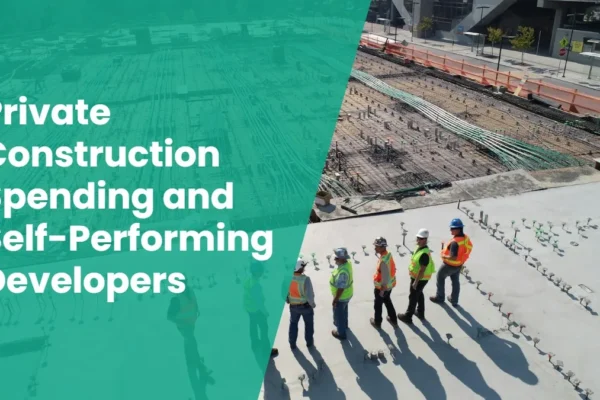
The Census Bureau’s August 2026 construction spending report showed private construction at an annual rate of $1,655.3 billion, up 1.1% on the month but 3.1% below a year earlier. Private residential spending was down 4.8% year on year. For real estate developers who act as their own general contractors, slower activity puts every budget line under the microscope. Technology that connects field decisions to financial records is moving from nice-to-have to necessary.
|
What to know
|
The August Data
According to the Census Bureau’s construction spending release for August 2026, published on 1 October 2026, total construction spending reached $2,203.1 billion at an annual rate, up 0.9% on the month but 1.7% below August 2025. Private construction rose 1.1% to $1,655.3 billion, a statistically significant monthly increase, but was 3.1% below the previous year.
Private residential spending stood at $882.3 billion, 4.8% lower than a year earlier.
Self-Performing Developers Under Pressure
Developers who self-perform take on both the developer’s and the contractor’s risks. They manage subcontractors, materials, schedules and safety while also answering to lenders and investors. In a slower market, margins on both sides tighten at once.
Visibility across construction and finance becomes the difference between profit and loss.
The Problem With Disconnected Systems
Many developers run construction in project management tools and finance in separate accounting software. Change orders approved on site may not reach the budget for weeks, and commitments may not be recorded until invoices arrive.
Integrated construction accounting software closes that gap by linking field activity directly to financial records.
Change Orders in Real Time
When a change order approved in the field updates the budget automatically, project managers see its financial impact before signing. That simple feature prevents many small overruns from adding up to large ones.
It also gives finance teams an accurate picture without chasing paperwork.
Budget Versus Actual by Cost Code
Tracking budgets against actual costs by project, phase and cost code, with automated variance alerts, reveals problems while there is still time to act. Generic accounting systems rarely provide this level of detail for construction.
Cost codes used consistently across projects also make benchmarking possible.
AIA Billing and Retainage
Progress billing on AIA G702 and G703 forms, retainage tracking and release schedules are core tasks for self-performing developers. Generating these documents from project data reduces errors and speeds up payment.
Retainage recaps on each payment request help avoid disputes with subcontractors.
Taller buildings add a further question, which is how people will move through them. lift modernisation traffic analysis is one way design teams test waiting times before decisions are fixed, and AdSimulo builds tools for exactly that work.
Subcontractor Compliance
Tracking insurance certificates, lien waivers, W-9s and payment history in one place protects developers from compliance gaps. Automated alerts for expiring certificates prevent unpleasant surprises.
Good compliance records also speed up lender reviews.
Land and Construction Together
For developers building on their own land, horizontal and vertical costs belong in the same view. Land acquisition, entitlements and infrastructure feed into the cost of each finished home or building.
Combining construction tools with land development software shows the full cost of every lot from acquisition to completion.
Draw Packages
Construction lenders require detailed draw packages. Elevate Solutions says manual draw packages can take six to eight hours per project per month, while its software reduces that to under 30 minutes.
Faster draws improve cash flow and reduce interest carry.
Mobile Access for Superintendents
Superintendents and project managers need access to budgets and approvals on site. Cloud platforms with mobile access let field teams update information as work happens.
Elevate Solutions offers unlimited users with no per-seat fees, which makes broad access affordable.
Security and Reliability
Construction financial data must be secure and available. Elevate Solutions says its software runs on Amazon Web Services, with an annual independent SOC audit of Acumatica’s cloud ERP.
Reliable hosting matters when crews and lenders depend on timely information.
A useful companion read is Article Forge Hub’s explainer on why developers are leaving spreadsheets behind.
Implementation
Developers moving from spreadsheets or separate tools should start with consistent cost codes, budgets and commitments, then add billing and compliance workflows. Elevate Solutions lists Excel, QuickBooks, Sage and Yardi among the systems customers typically migrate from.
The company says typical implementations take 8 to 12 weeks.
What Self-Performing Developers Need to Track
Developers who self-perform take on labour, equipment and materials risk that would otherwise sit with a contractor. That means tracking crew hours, equipment usage and material deliveries against each cost code, not only invoices. Without that detail, it is hard to know whether a phase is truly on budget until it is too late.
Linking field data to accounting also helps with cash planning. When committed costs, approved change orders and upcoming draws sit in one place, finance teams can forecast more accurately and avoid surprises.
Preparing for a Busier Market
Lower spending today does not last forever. Firms that use quieter periods to refine processes, train staff on their systems and clean up historical cost data will be ready to bid confidently when activity picks up again.
The Takeaway
August 2026’s construction spending data shows private activity below last year’s level. Developers who self-perform can protect margins by connecting field decisions, budgets and accounting in one integrated construction management system.
How long does it take a field change order to reach your budget today?